Pages

Thursday, June 3, 2010

Beating Some Common Sense into Interactive Applications


Imbuing computers with "common sense" has long been a holy grail of computer programmers and users alike. This article detailed some of the various attempts by researchers at the MIT media lab to create such AI systems that could do things such as discern user meaning without direct statements of mood, or suggest images and pictures based on content.

As Stephen and I mentioned in class, while reading this article we kept picturing the loathsome Microsoft paperclip. The paperclip was designed to facilitate document creation, however users HATED it. The application was intrusive and insulting (not to mention smug).

I think it is important to note that not only must these common sense systems understand content and context they must also have the sense to recognize user need. In general people hate being offered help or advice when they were not seeking it or when they were intent upon solving a problem themselves, it makes the person feel inadequate, or less than.

As I type this blog post I realize a successful "common sense" application that users have been using and loving for well over a decade now; the spellchecker. The spellchecker is unobtrusive as it does not immediately demand my attention. It simply underlines misspelled words that I can fix in the moment or go back through my document and correct all at once. In addition the spellchecker does not pretend to be my friend in the way that the paper clip does, it simply is. I want my machines to support and expand my sentience, not compete with it.

Tuesday, April 6, 2010

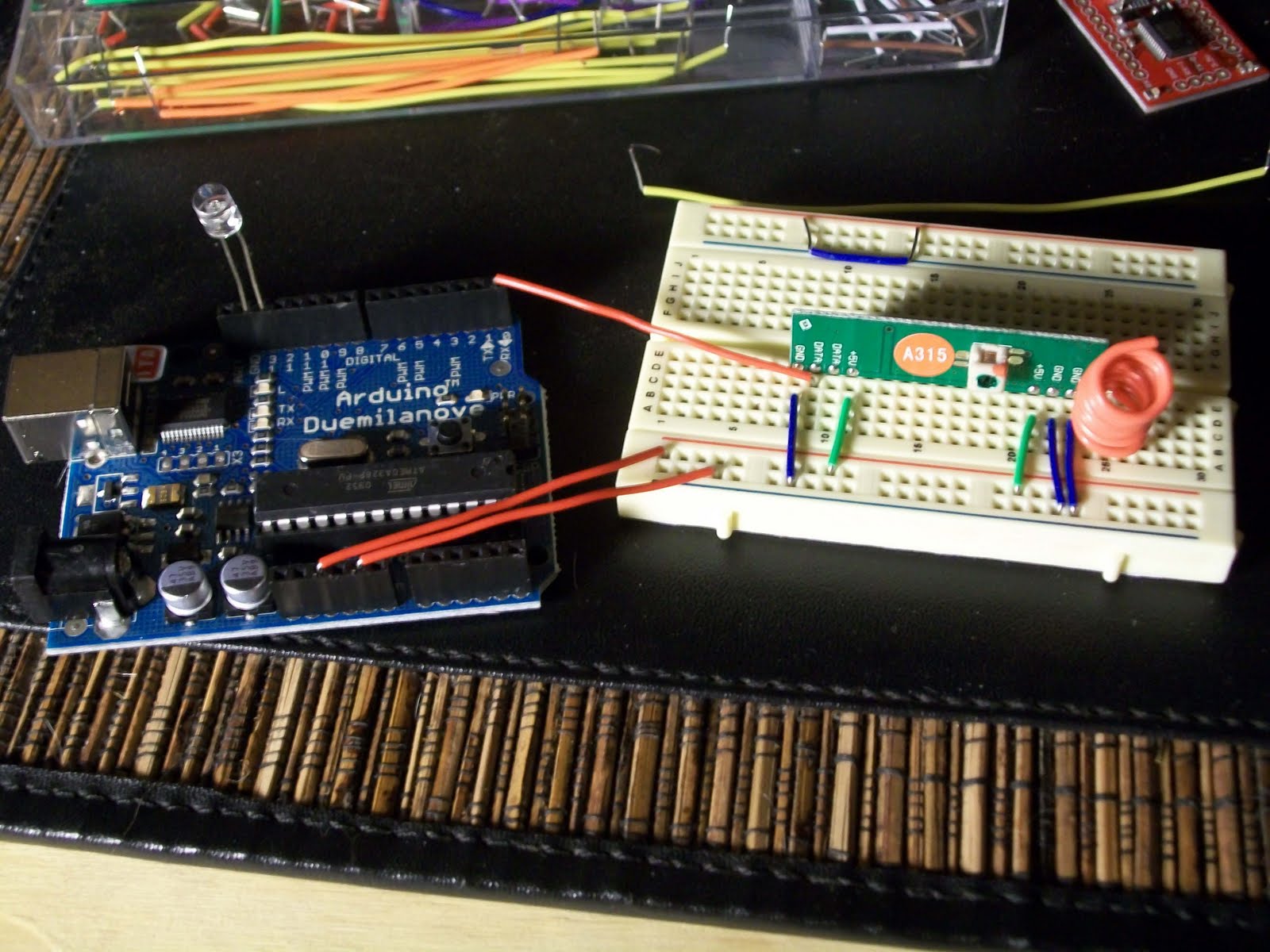
Arduino radio TX/RX


It's late and I'm tired. Here is most recent shots of progress on radio TX and Arduino RX . This is more for my game project for the locating device but the things i have learned working on it apply to the mood broadcaster that I am working on as well. I modified another example I read in which the person used a 555 timer and potentiometer to blink an LED w/o an MCU or any other device. It was my hope that instead of the output timer of the 555 timer leading to an anode of an LED i would instead hook it to the data pin of the TX. I could than theoretically use the potentiometer to input values to the 555 and continually "blink" or broadcast that specific value out. The arduino with the FM receiver hooked to the RX or 0 pin of the microcontoller could than be told to listen for and return only that value or above that is being broadcast from the independent TX circuit.When the value was detected it could turn on the LED (and later scroll text in an LCD), hooked to pin 13 and ground of the MCU. This is my theory or method thus far. SO far i am not sure if its responding correctly or not. RIght now my hunch is that something is still amiss. I believe i need to test it with a 100k ohm Potentiometer as right now I am only using a 10kohm pot.

Tuesday, March 23, 2010

Future of digital Studies Conference

I attended the Futures of Digital Studies Conference with Francesca over this past weekend. As you have probably already read the conference was maligned by some technical problems, though from what I could tell not the fault of Digital Worlds, and in true new media theorist fashion the conference goers quickly re-appropriated these technical issues as grounds for further theorization.

As much as I enjoy the lofty discussions and theorization on what all this "digital stuff" means to us as a culture, in tongue and cheek, I came to the realization that anyone could write a critical discourse on new media by following this simple formula. 1)combine antithetical statements with 2) made up words and 3) sprinkle with digi- or techno- prefixes and suffixes.

To cope with the reverberating feedback coming over the speakers Francesca and I took turns adding words to a page to write our first discourse on New Media. Here it is:

We incorporate the incorporeal personal meta-verse through electro-plate tectonics with bipartisan unilateral machinic politics in order to augment dematerialized techno-cultural
holons. Technopaganism cross-polinates Norse-Luddism to create hypertextualility in
context of finitely disembodied passively proactive emotional cyber conversion. Ipso facto
digital genitalia converges stationary nomadism's radically pro-viral paleo-conservative
agenda with pseudo-Foucaultian phallic decentering.

Hope you all enjoy it and keep adding to it in the comments!

Wednesday, January 27, 2010

I HAVE A BLOG!

And yes even though any mammal with internet access can have one as well I still feel a sense of accomplishment. Not for any feat of digital wizardry but for the fact that i finally got around to it.

Myself like many people with apposable thumbs was initially opposed to blogs, largely for the dumb as fuck name. The asisninity of the meaningless name perfectly captured the inherent nothingness of our culture.

I thought I wasn't an early adopter. As John Stewart quips in his polemic against the mass medias bandwagoning of twitter, "New does not automatically equate to good". I realized however I was only not an earlier adopter to things I hadn't discovered first. Resistence to internet weblogs was only an insecurity: "What if i throw a blog and nobody comes." (on a side note it's funny that blogger recognizes the word blogging, blogger, and blogs but not weblogs, their origin name, in its spell checker)

I overcame this wariness of blogging when I began this january to be required to post to a blog as part of a graduate seminar in digital arts and science. What really brougth me around to the power of blogs was the realization that you do not write blogs for others but for yourself. I now have my own personal searchable database of everything i've written or ever thought was cool. Also i didn't want this awesome name to be taken by a schmoe.

So in the spirit of blogs i leave you with a probable misquote, as Yogi Berra famously said "Blogging is 90% mental and the other half is physical."


F1RST POST!!!

Obligatory F1RST POST!!!WOOT!